
HOW TO PLAY / FIELD NOTES
RIDGE RIG: throttle, balance and reading a moving road
Learn how the same two pedals control speed on the ground and attitude in the air, then approach each mechanism on its own terms.
- Devices
- Desktop · Tablet · Phone
- Players
- Single player
- Language & sound
- English / 中文 · Starts muted
Is this your kind of game?
For players who enjoy learning a physical route through retries and small corrections.
Controls at a glance
Right/D applies throttle and raises the nose in the air; Left/A brakes, reverses and lowers the nose in the air. Touchscreens use a left brake/reverse pedal and right throttle pedal in landscape. R retries; P/Esc pauses.
Separate speed from attitude
On the ground, build speed when the route gives you space. Before a sharp crest or compression, release the throttle or brake early enough to keep a controllable take-off. Holding maximum throttle cannot solve a bad landing angle.
In the air, throttle raises the nose and brake lowers it. Use short inputs and compare the wheel line with the slope ahead. Aim to meet the landing with the wheels aligned to the surface; an unnecessary extra correction near contact can turn a recoverable jump into a roof-first landing.
Moving surfaces need different approaches
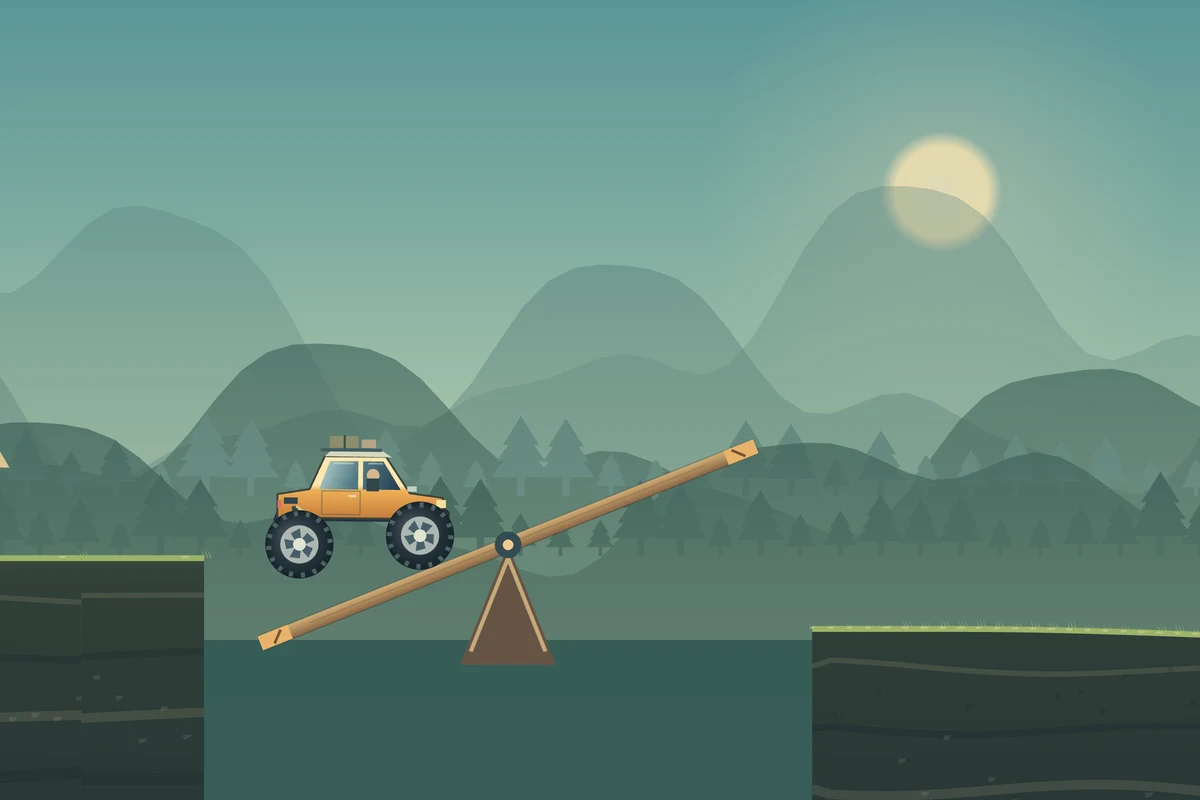
A seesaw shifts under the vehicle’s weight. Approach with enough control to feel that movement rather than treating it as a fixed ramp. Rope bridges sag, rotating drums change wheel contact, and a crate must settle on a pressure plate before its mechanism is useful.
Read paired hazards as one section. Wind above a bridge can change your balance; a spring followed by low gravity changes the time available for correcting a landing. The next mechanism often matters before you have left the current one.
Water is not another strip of road
Slow into the approach hollow when you need to collect float tires: a fast pass can miss the pickup. Once afloat, buoyancy and propulsion differ from driving on solid ground, so use small attitude corrections instead of expecting the wheels to pull you out.
For brittle surfaces, keep enough momentum to leave before the route gives way. For a steep landing, prioritize alignment. The useful question is not “should I always go slowly?” but “what speed and angle does the next contact need?”
Use retries to learn one section at a time
Routes are fixed for each stage, so a retry is an opportunity to change one input rather than relearn a random map. Note where you started braking, how you left the crest and which wheel contacted first.
A retry restores the checkpoint and its mechanisms; refreshing also counts as a retry. Practice mode is useful for learning a vehicle, while campaign progress and vehicle records remain distinct. Choose an unlocked vehicle for a campaign attempt instead of assuming that selecting a vehicle requires practice mode.
Progress & backups
Unlocks, records and checkpoint progress are kept locally. Returning to a saved checkpoint after a refresh adds a retry. No cloud account is provided; keep the same browser storage to retain progress.
Language follows this portal. To change it, choose EN / 中文 here and open the game again. Each visit starts with sound off; enable it in the game if you want audio.
Ready for a run?
You might also explore: APEX RUN · All guides
Found an outdated instruction or a control issue? Send the game name, device and steps to reproduce it to brucexiamh@gmail.com.