
HOW TO PLAY / FIELD NOTES
NUMBER STRIDE: change lanes, compare formulas and plan beyond one gate
A moving three-lane calculation puzzle. Learn why the same operation can be good or bad depending on your current number and the gates ahead.
- Devices
- Desktop · Tablet · Phone
- Players
- Single player
- Language & sound
- English / 中文 · Starts muted
Is this your kind of game?
For players who enjoy mental arithmetic under a continuous running rhythm.
Controls at a glance
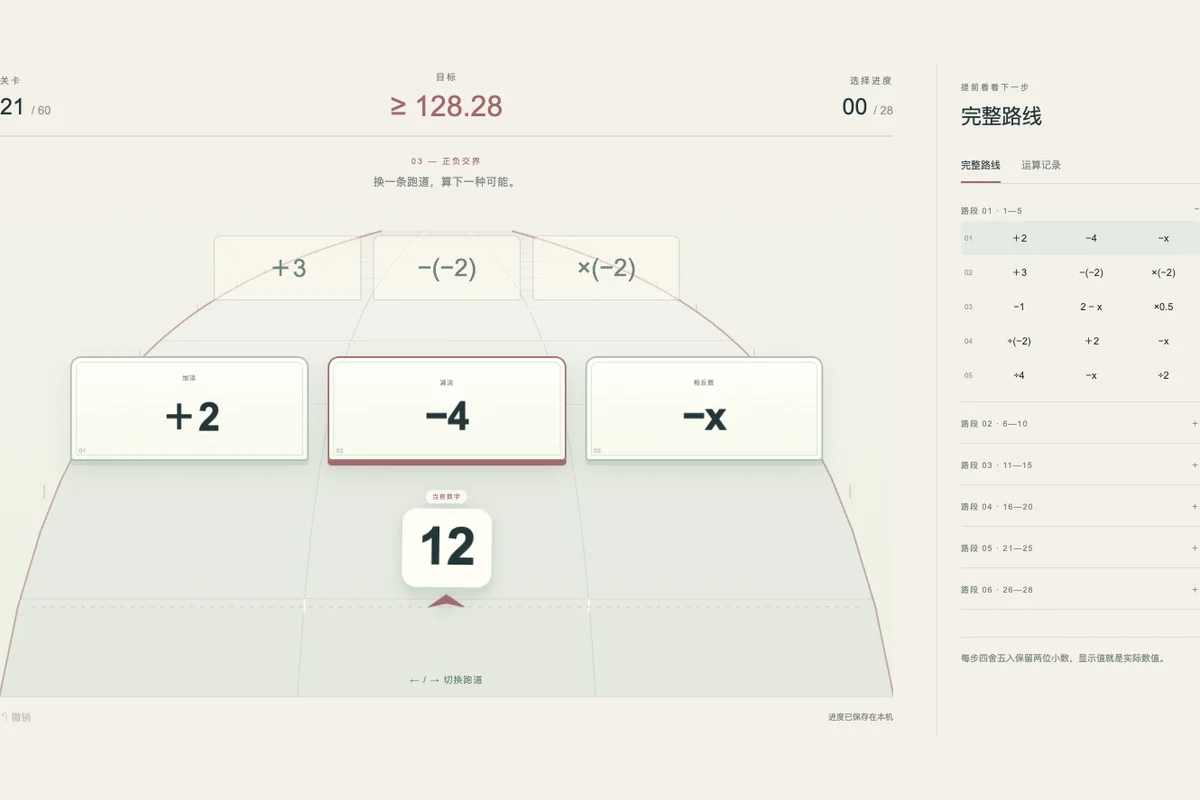
Press Left or Right to change one lane on desktop; swipe left or right on touchscreens. The runner moves forward automatically. Z undoes, R restarts and P/Esc pauses. The pause screen covers the formulas; route preview does not stop the run.
The finish decides the result
Read the starting value and target before setting off. Every gate row offers a choice, but passing the target early does not end the stage. Finish the full route with a displayed value at least equal to the target.
Make a lane change before you reach the gate, not when its calculation has already applied. Each press or swipe moves one lane, so crossing from one outside lane to the other needs two changes. Look ahead rather than watching only the result of the previous calculation.
Compare results, not operation symbols
With a starting value of 6, +5 gives 11, ×2 gives 12 and ÷0.4 gives 15. Division can increase a positive value when the divisor is between zero and one. Likewise, subtracting a negative number increases the result.
A useful shortcut is to notice the threshold where options trade places: +5 is better than ×2 below 5, ties it at 5 and loses above 5. These examples explain the arithmetic; they are not a promise that a particular gate appears in your next stage.
Plan for signs and later transformations
Later formulas include operations such as powers, roots, absolute value and reciprocals. A large negative value may become useful before a square, while a reciprocal can reverse which positive value is preferable. The biggest result at the current gate is not always the best final route.
Read invalid-gate markers. A zero or negative result is not automatically a failure, but an undefined or out-of-range operation is. Values are rounded after each operation, so use the displayed current value as the next input instead of carrying hidden extra decimals in your head.
Improve a route without losing the running rhythm
The early stages mix integer addition, multiplication, subtraction and division. Use them to practise comparing alternatives quickly. Later stages ask for more planning; consult the route preview while remembering that movement continues.
A lost run is useful information: identify the first gate where your plan became unhelpful, then try a different branch. Stars reward a stronger finish, and the current stage targets were recalibrated against reachable routes. Aim for the next star without assuming that the only acceptable result is a theoretical perfect maximum.
Progress & backups
Each completed gate is saved locally so you can resume from a stable point. Previous records and unlocks are retained across the recent numerical update; a run already in progress keeps its original calculations until you start it again.
Language follows this portal. To change it, choose EN / 中文 here and open the game again. Each visit starts with sound off; enable it in the game if you want audio.
Ready for a run?
You might also explore: MICROSEA · All guides
Found an outdated instruction or a control issue? Send the game name, device and steps to reproduce it to brucexiamh@gmail.com.